Both Rwanda and Uganda offer mountain gorilla trekking through some of the most remarkable highland forest in East Africa, and both are genuinely outstanding. They are also meaningfully different in character, cost, logistics, and what surrounds the trek. The right choice comes down to what you are looking for and how much time you have. I'll lay out the honest trade-offs, the real permit numbers, what a trek day actually involves, and how we'd pair either country with the rest of your trip.
USD 1,500
Rwanda permit
USD 800
Uganda permit
1 hr
With the gorillas
Max 8
Trekkers per group
What Gorilla Trekking Actually Is
There are roughly 1,000 mountain gorillas left in the world, and they live in just two places: the Virunga Massif, the chain of volcanoes shared by Rwanda's Volcanoes National Park and Uganda's Mgahinga, and Uganda's Bwindi Impenetrable Forest. About half the world's mountain gorillas are in Bwindi alone. There is nowhere else on earth to see them in the wild.
A trek works like this. You set out in the morning with a guide and trackers, who have usually picked up the family's location at first light. You walk in, sometimes for under an hour, sometimes for the better part of a day, until you reach the group. Then you get one hour with them. One hour watching a silverback move through the undergrowth, juveniles tumbling out of low branches, a mother cradling an infant a few metres from your boots. Groups are capped at eight trekkers per family per day, so it never feels like a crowd. The hour with the gorillas is the same calibre in both countries. The gorillas are not the deciding factor. Everything around them is.
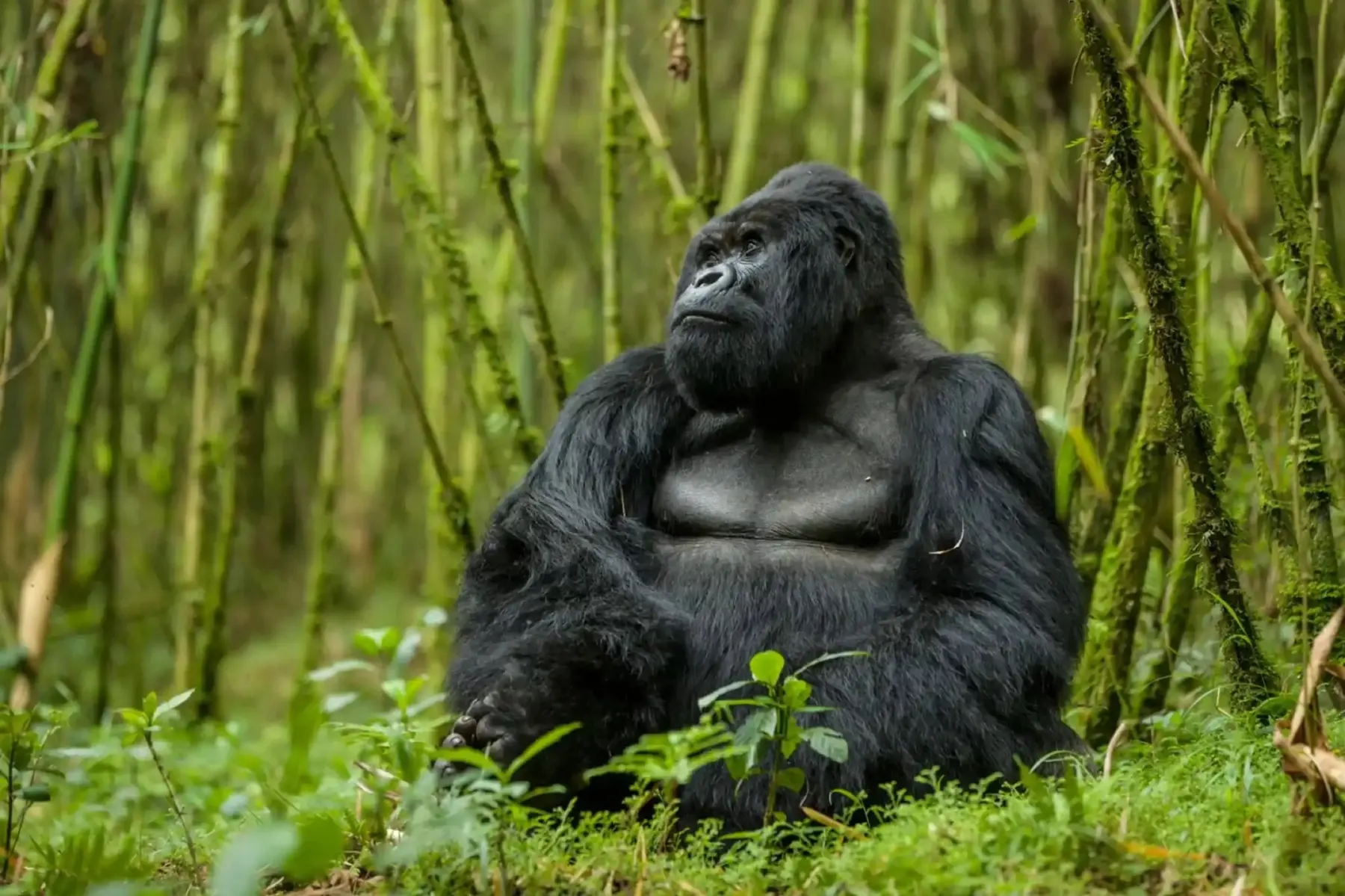
A silverback mountain gorilla, one of roughly 1,000 left in the wild. The hour you spend with a habituated family is hard to put into words afterwards.
The Gorilla Map
Where You Actually Trek
Rwanda's gorillas live in one park near Kigali. Uganda's are spread across Bwindi's four sectors and Mgahinga down on the Virunga border. Scroll through each one, or tap Rwanda or Uganda below, and the map shows you where it sits, how you get there, what the permit costs, and what to pair it with.
RwandaVolcanoes National Park
Volcanoes National Park
Rwanda · Volcanoes NP Uganda · Bwindi & Mgahinga
Map tiles: Esri, National Geographic. Trailhead positions are indicative.
Rwanda · Volcanoes NP
The fast, premium choice near Kigali
Rwanda's gorillas live in Volcanoes National Park in the country's northwest, on the Virunga side. The trailheads are only two to three hours' drive from Kigali airport, which makes this the easiest gorilla access in East Africa, you can land and be trekking the next morning. The terrain is more open than Bwindi, climbing the flanks of dormant volcanoes through bamboo and Hagenia forest, with several habituated families to choose from. The permit is USD 1,500 per person, the highest of the options, and the lodges at the top end are some of the finest on the continent: Bisate, Singita Kwitonda and a handful of others with extraordinary crater views.
Our take: Choose Rwanda when time is tight or you want the most polished, lowest-friction trip. It pairs beautifully with a Tanzania or Kenya safari because the travel time is so short. Full numbers in our Rwanda gorilla trekking cost guide.
Uganda · Bwindi Buhoma
The classic northern gateway to Bwindi
Buhoma in the north of Bwindi is the original, best-known trekking sector, with several long-habituated families and a good spread of lodges from value to high-end. Bwindi itself is exactly what the name suggests: dense, dark, cathedral-like forest on steep hillsides. The trekking is usually more demanding than Rwanda, longer and steeper through thick vegetation, and a lot of travellers find that wildness is the whole point. Uganda's permit is USD 800 per person, less than half Rwanda's, which adds up fast for a group.
Our take: A strong base for a first Bwindi trek, and easy to combine with Queen Elizabeth National Park a few hours north. See the Uganda gorilla trekking cost guide for the full breakdown.
Uganda · Bwindi Ruhija
The high, quiet eastern sector
Ruhija sits high on the eastern side of Bwindi and is the quietest of the four sectors. It is excellent for birdlife as well as gorillas, the cool montane forest holds a lot of Albertine Rift endemics, and the treks here can be among the more strenuous in the park because of the altitude and the gradients. Fewer trekkers come through, so it feels remote in the best way. The USD 800 permit applies here too.
Our take: A good pick if you want Bwindi without the busier feel of Buhoma, and you're up for a proper walk. We'll match the sector to your fitness when we plan the days.
Uganda · Bwindi Rushaga
Home of the habituation experience
Rushaga in the south of Bwindi has the most habituated families of any sector, and it's the only place you can do the gorilla habituation experience: up to four hours with a semi-habituated group, alongside the trackers and researchers doing the work, rather than the standard one hour. That permit is USD 1,500 per person, the same as a Rwanda permit, and numbers are tightly limited. For anyone who wants more time and a deeper, less polished encounter, this is it.
Our take: If the hour never feels like enough, Rushaga is where we'd send you. It needs booking a long way ahead. Read our full gorilla habituation experience guide before you decide.
Uganda · Bwindi Nkuringo
The dramatic, demanding south
Nkuringo, also in the south, has some of the most dramatic scenery in Bwindi and a reputation for tough, rewarding treks, steep descents into the forest and a hard climb back out. The views over the Virungas from the ridge are superb, and there's a cluster of good lodges perched up high. This is the sector for travellers who want the physical challenge to match the encounter. The standard USD 800 permit applies.
Our take: For fit, keen walkers who want Bwindi at its wildest. We'd line up a porter for you here without being asked, the climb out earns its reputation.
Uganda · Mgahinga NP
The small Virunga park on the border
Mgahinga is Uganda's other gorilla park, a small, scenic reserve in the far southwest on the Virunga volcanoes, right where Uganda, Rwanda and the DRC meet. It has one habituated family, so it's less of a sure thing than Bwindi, but it's beautiful and uncrowded, and it pairs well with golden monkey trekking on the same slopes. The same USD 800 permit applies. It's a lovely add-on rather than the main event.
Our take: Worth it as part of a longer southwest Uganda loop, especially alongside the golden monkeys. We'd build Bwindi as your primary gorilla day and treat Mgahinga as the bonus.
Rwanda: Volcanoes National Park
Rwanda's pitch is ease and polish. Volcanoes National Park is two to three hours from Kigali airport, so you lose almost no time getting in, and the trekking on the open volcano slopes through bamboo and Hagenia forest is generally more forgiving than Bwindi. Treks still range from under an hour to five or six hours depending on where the family has moved overnight, so it's never a stroll, but the ground is kinder. Rwanda's permit is USD 1,500 per person, and the country has leaned hard into high-end conservation tourism. Bisate, Singita Kwitonda and One&Only Gorilla's Nest are among the finest wilderness lodges in Africa. Kigali itself is clean, calm and genuinely worth a night rather than a place to rush through.
Rwanda also has more to offer than gorillas alone. There's golden monkey trekking in the Virungas that slots neatly onto a gorilla day, and Nyungwe Forest in the south holds chimpanzees and a spectacular canopy walkway. It isn't a big-game savanna destination, but for primates and forest it's superb.
Choose Rwanda if: time is tight, you want the highest-end lodges, you'd rather a short and efficient itinerary, or you're combining gorillas with a Tanzania or Kenya safari and want to keep travel time down.
Trekking in Rwanda's Volcanoes National Park, climbing through bamboo and Hagenia forest on the flanks of the volcanoes, with Kigali just a couple of hours behind you.
Uganda: Bwindi Impenetrable Forest
Uganda's pitch is value, variety and a wilder trek. Bwindi is dense primary forest on steep terrain, and the trekking is typically harder than Rwanda, longer, steeper, through thick vegetation, with more variable conditions. Plenty of travellers find that's exactly what they wanted: the sense of having earned the encounter is real. The permit is USD 800 per person, less than half Rwanda's, and Bwindi has four trekking sectors (Buhoma, Ruhija, Rushaga and Nkuringo) plus the Mgahinga option, so there's more capacity and more flexibility on dates. Getting in takes longer, six to eight hours by road from Entebbe through lovely southwestern Uganda, or a light-aircraft hop to the airstrips near the park, which we recommend on any trip of five days or more.
Uganda's real advantage is everything else the country gives you. Queen Elizabeth National Park is a few hours from Bwindi and offers tree-climbing lions in the Ishasha sector, the boat safari on the Kazinga Channel with hippo, buffalo and elephant at close range, and open savanna game viewing that balances the forest perfectly. Kibale Forest has the highest chimpanzee density in Africa and a chimp habituation experience that's one of the best primate days anywhere. Murchison Falls in the north is the Nile forced through a narrow gorge, with elephants on the banks and a superb boat cruise. You can build a real two-week safari around Uganda without leaving the country.
Choose Uganda if: budget matters, you want to combine gorillas with chimps and savanna game, you'd rather a more immersive trek, you have five or more days, or you want Queen Elizabeth and Kibale in the mix.
Bwindi Impenetrable Forest. The trekking is more demanding than Rwanda, through dense forest on steep ground, and a lot of guests find that wildness is exactly the point.
The Permit Reality
Permits are the part people get tangled up in, so here it is plainly. A Rwanda gorilla permit is USD 1,500 per person. A Uganda standard permit is USD 800 per person. Uganda's habituation experience, the four-hour option in Rushaga, is USD 1,500 per person, the same as a standard Rwanda permit. In every case the permit buys your time with the gorillas (one hour on a standard trek, up to four on habituation), an official guide and park entry. Porters, trailhead transfers, accommodation and the rest of the trip are all separate.
Permits are limited and need booking ahead. In the dry-season peak, roughly June to September and over December, you want your dates locked six to twelve months out, especially for Rwanda's smaller daily allocation and for Uganda's scarce habituation permits. Outside those windows, three to six months is usually enough. We handle the entire permit process for the trips we run, you don't navigate any of it, but the earlier you confirm your dates and country, the better your odds of getting the family and the lodges you want.
You'll start early. After a briefing at the park headquarters you're assigned a gorilla family and set off on foot, following trackers who've usually located the group at first light. From there a trek can be anything from one to eight hours round trip, at altitude, through forest that ranges from open bamboo in Rwanda to thick, steep undergrowth in Bwindi. There's no way to know in advance which you'll get, the gorillas move overnight and the trackers go where the family went. Once you reach them, the clock starts on your hour (or four, on habituation), and the guides keep you at a respectful distance.
This is a moderate-to-challenging activity, not a gentle walk. The altitude alone makes the climbs harder than the same effort at sea level, and wet ground is common because this is rainforest. The drier months, roughly June to September and December to February, mean firmer trails and easier going, but trekking runs all year and you should expect some mud whenever you come. Porters are available in both countries, and I'd take one every time. They carry your day pack, give you a hand on the slippery bits, and the fee goes straight to people from the communities around the park, which is conservation working the way it should.
Can You Do Both?
Yes, and for travellers with enough time and budget, a combined Rwanda and Uganda gorilla trip is genuinely compelling. A typical shape is four nights in Uganda (Bwindi for the gorillas, Queen Elizabeth for game drives and the Kazinga boat safari) followed by two nights at a lodge like Bisate in Rwanda. You come away with the full range: a demanding forest trek, a polished crater-rim stay, open savanna driving and a boat cruise on one of Africa's most productive waterways. We build this circuit regularly, sometimes with a Tanzania or Kenya safari extension on the end.
The Australian Angle: Routing, Lead Time and Pairing
Most of our clients are Australian, so a few practical points. Getting there is simpler than people expect. For Rwanda and Volcanoes you fly into Kigali (KGL); for Uganda and Bwindi you fly into Entebbe (EBB). From the east coast of Australia you'll connect through a major African hub, and we lay out the exact flight plan once we have your dates. We usually route via Singapore, Johannesburg or Addis Ababa.
On lead time, treat a gorilla trip as a nine-to-twelve-month booking for peak dry-season dates, longer if you want the habituation permit or a marquee Rwanda lodge. The permits and the best rooms genuinely do go that early. And on pairing, this is where gorillas earn their place in a bigger trip. Rwanda slots cleanly onto a Tanzania or Kenya safari thanks to the short transfer from Kigali. Uganda is the one to choose if you want to fold in chimpanzee trekking at Kibale and savanna game at Queen Elizabeth without leaving the country. Tell us the wider trip and we'll build the gorillas into it properly.
How We Place You Right
Here's what "no third parties, no middlemen" means for a gorilla trip. We book the permits, the lodges and the ground ourselves, so there's nobody between us and the parks marking the trip up or guessing at availability. More importantly, we match you to the right country and the right sector for your fitness, your budget and what else you want from the trip, rather than selling whatever's easiest to book. A keen walker who wants four hours with a semi-wild group goes to Rushaga. A family on a tight window with a Serengeti safari already booked goes to Rwanda. Same gorillas, very different trips, and the difference is in the matching.
Not sure which country suits you? Tell us your dates, your budget and how much walking you're up for, and we'll tell you honestly where we'd send you and why. Start a conversation or run a quick estimate to see what's involved.
Other primates: Rwanda golden monkeys, Nyungwe chimps | Uganda Kibale chimps, golden monkeys at Mgahinga
Wider safari: Rwanda limited big game | Uganda Queen Elizabeth, Kibale, Murchison Falls
Best paired with: Both combine well with a Tanzania or Kenya safari
Frequently Asked Questions
How much does a gorilla permit cost in Rwanda vs Uganda?
Rwanda's gorilla permit is USD 1,500 per person. Uganda's standard permit is USD 800 per person, less than half the price. Uganda also offers a gorilla habituation experience at USD 1,500 per person, which gives you four hours with a semi-habituated group rather than the standard one hour. The permit covers your time with the gorillas, an official guide and park entry. Porters, transfers, accommodation and everything else are separate. We book all permits ourselves for the trips we run.
What is the best time of year for gorilla trekking?
Both countries can be trekked year round. The drier months, roughly June to September and December to February, mean firmer trails and easier walking. Trekking still runs in the wetter months and the gorillas do not change their behaviour seasonally, but you should expect some mud at any time of year since this is rainforest. Permits are scarcer in the dry-season peak, so book those dates well ahead.
How fit do I need to be for gorilla trekking?
Moderate to challenging fitness. A trek can run anywhere from one to eight hours round trip at altitude through forest, depending on where the gorilla family has moved overnight. Rwanda's treks in Volcanoes National Park tend to be shorter and on more open volcano slopes. Uganda's Bwindi treks are usually longer and steeper through dense forest. Porters are available in both countries to carry your bag and give you a hand on the climbs, and we recommend taking one. There is no strict upper age limit and guests in their 70s trek successfully with sensible preparation.
What is the gorilla habituation experience?
The habituation experience is a Uganda-only option in the Rushaga sector of Bwindi. Instead of the standard one hour with a fully habituated family, you spend up to four hours with a group that's still being habituated, alongside the researchers and trackers doing that work. The permit is USD 1,500 per person, the same as a standard Rwanda permit. Numbers are very limited, so it needs booking a long way ahead. Our gorilla habituation experience guide covers it in full.
Rwanda or Uganda, which should I choose?
It comes down to budget, time and what else you want from the trip. Rwanda gives you the fastest, easiest access, trailheads are two to three hours from Kigali airport, plus the highest-end lodges and a premium permit. Uganda gives you a cheaper permit, more sectors and availability, a longer journey in, and the easiest pairing with chimpanzee trekking in Kibale and savanna game in Queen Elizabeth National Park. Both are excellent. Tell us your fitness, budget and the wider trip and we'll match you to the right country and sector.
Is it safe to trek gorillas?
Yes. Both Rwanda and Uganda have long-established gorilla trekking programmes with strong safety records. Habituated groups are accustomed to human presence, and guides and trackers accompany every group. Standard health protocols apply, you must not trek if you're unwell, to protect the gorillas from human disease, and groups are capped at eight trekkers per family per day.
Ready to Experience This?
Let us plan your trip
Every safari we build is tailored to you, the right country and sector for your fitness and budget, the permits and lodges handled. Tell us your dates and we’ll take it from there.
Pick up the phone if you'd rather talk it through. We spend a good part of the year moving between Australia and Africa, so if we miss you, WhatsApp Samara and we'll come back to you whatever the time zone.
Safaris · enquiries & bookings
Samara Imhoof
Bookings & Client Care
Whether you're just kicking around ideas or already booked. Dates, lodges, costs, changes, payments, flights.